ٹریفک کے قواعد
رُکنا اور پارکنگ
پارکنگ کے قواعد، نشانات، وقت کی حدیں اور محفوظ طریقے سے پارک کرنے کے اقدامات مرحلہ بہ مرحلہ سیکھیں۔
1. Stopping or parking?
Waiting for somebody normally counts as parking, even if you stay in the car, leave the engine running or wait only a minute. Being stationary because traffic requires it or to avoid danger is different. Active boarding, alighting, loading and unloading do not count as parking.
Example: Your friend is still inside a shop. Waiting outside is parking, so a no-parking restriction applies. Hazard lights do not give you an exemption.
2. Read the location before choosing it
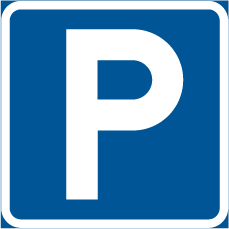
First check that the car will not create danger, obscure the view or obstruct traffic. Then read signs, zone rules, arrows, times and road markings. A P sign does not automatically override general prohibitions, such as those near a pedestrian crossing.
A P sign may apply to an entire car park or a stretch on the side of the road where it stands. Check where the restriction starts and ends. A zone sign can apply throughout an area without being repeated on every street.
3. Places where stopping is prohibited
Do not stop on or within 10 metres before a pedestrian crossing, cycle passage or cycle crossing. Stopping is also prohibited in a junction and within 10 metres of the nearest edge of the intersecting carriageway. At a crossing the distance applies before it; at a junction the junction rule also applies after it.
Do not stop in a tunnel, cycle lane, hatched exclusion area or roundabout, or where a bend or hillcrest obstructs visibility. A car must not stop on a footpath or cycle path. If a bus stop has no marked limits, its restriction normally covers 20 metres before and 5 metres after the stop sign; boarding or alighting is allowed only without obstructing public transport.
4. No parking and no stopping


C35 prohibits parking. C39 prohibits both stopping and parking. At C35, genuine active boarding, alighting or loading may be allowed if no other restriction applies. At C39 you may not stop for those purposes. Being forced to stand still by traffic is a different situation.
Do not park so that you block a driveway, within 30 metres of a level crossing, or normally on a priority road unless parking is specifically permitted. Do not double-park beside an ordinary parked car. Also check yellow edge markings and reserved spaces.
5. How to read the times
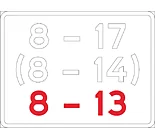
Black or white times without brackets apply on weekdays except the day before a Sunday or public holiday. Times in brackets apply on the weekday before a Sunday or public holiday, often Saturday. Red times apply on Sundays and public holidays. Check the calendar: a day before a public holiday can fall in the middle of the week.
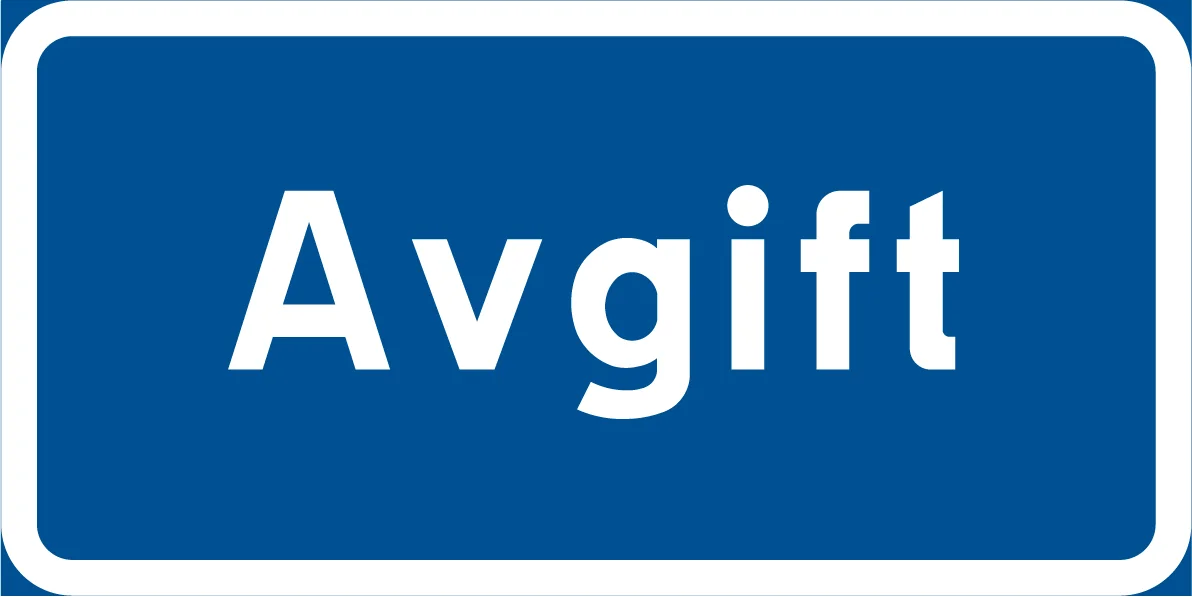
Read each condition with its panel. Two hours on one panel and Fee 8–18 on another means the two-hour limit applies throughout, but the fee applies during the stated hours. If 2 hours, Fee and 8–18 share one panel, those conditions apply together during those hours. Other rules can still restrict parking.
6. Parking disc and payment
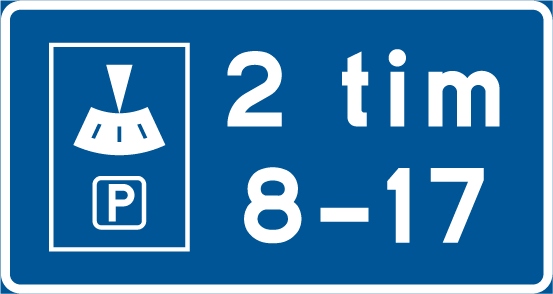
When a parking disc is required, set it to the next half-hour: arrival at 10:10 means 10:30; arrival at 10:35 means 11:00. If you arrive at 07:40 and the restricted period starts at 08:00, set 08:00 if you will stay beyond then. Display it at the front with the time readable from outside. Do not simply move the time forward while leaving the car parked.
When paying, check the registration number, zone code, start time and end time. Payment does not override a maximum stay. A free space may still require a ticket or disc. Also read conditions for charging bays, resident permits and accessible parking permits.
7. Daily limits and date parking
The general maximum of 24 consecutive hours applies on municipal public places in built-up areas and within public-road areas on weekdays except the day before a Sunday or public holiday. Posted special conditions can set a different limit. Do not assume an unsigned space allows unlimited parking.
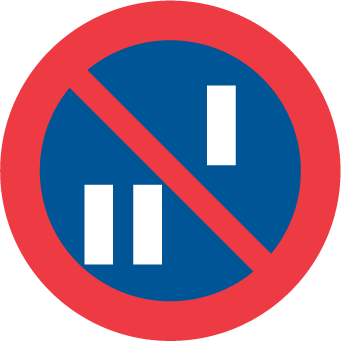
C38 prohibits parking on the even-address side on even dates and on the odd-address side on odd dates. Read the hours when it applies. For overnight parking, consider the date after midnight: when the rule applies on the 16th, the even-address side is prohibited.
8. Park the car step by step
Choose a legal space with enough room. Check mirrors and your blind spot, signal your intention in good time and slow smoothly. Look for pedestrians, cyclists, children and obstacles all around the car. Reverse only when it can be done without danger or obstruction to others.
Reverse at a crawl, moving your attention between your path, mirrors and surroundings. Cameras and sensors help but do not replace observation. Stop if you lose sight of the space or somebody approaches. Reset and try again rather than forcing the car into a gap.
9. Bay parking and parallel parking
For a parking bay: plan your turn, allow side clearance and guide the car slowly between the lines. Straighten the wheels and check that every wheel is inside the marking and doors can open safely. Adjust if needed. Follow any posted parking orientation.
For parallel parking: choose a gap with extra room, line up parallel with the car ahead and check all around. Reverse slowly towards the kerb, monitor the rear and watch that the front does not swing into traffic. Straighten and centre the car, leaving room for others to exit. Exact steering reference points depend on the car and gap; practise with your instructor or supervisor in a quiet place.
10. Before leaving or driving away
On an ordinary two-way street, normally park on the right in your direction of travel, aligned with the road. A one-way street can also allow the left side. Check that nobody is blocked. Apply the parking brake and select P or an appropriate gear according to the vehicle instructions. Secure the car especially on slopes so it cannot roll.
Check for cyclists and traffic before opening the door. Confirm payment or disc and the latest departure time. When pulling out, check all around, mirrors and your blind spot, signal and move only when safe. A signal does not give you priority.
Check your understanding
You wait in the car for someone shopping. Is that parking?
Yes. Staying inside does not change the purpose of the stop.
A parking disc is required. You arrive at 10:10. What time do you set?
10:30, the next half-hour. Also check the maximum stay.
May you stop five metres before a pedestrian crossing to let somebody out?
No. The prohibition covers stopping on and within ten metres before the crossing.
C38 applies tonight. After midnight it is the 16th. Which side is prohibited?
The side with even address numbers. Also check the posted hours.
You pay for four hours but the sign allows a maximum of two. May you stay four?
No. Payment does not change the maximum permitted stay.
Sources and further reading
Rules checked on 15 September 2026. Always follow the rules and signs at the location.